Posts

Apache Hadoop Admin Tricks and Tips

In this post I will share some tips I learned after using the Apache Hadoop environment for some years, and  doing many many workshops and courses. The information here considers Apache Hadoop around version 2.9, but it could probably be extended to other similar versions. These are considerations for when building or using a Hadoop cluster. Some are considerations over the Cloudera distribution. Anyway, hope it helps!  Don't use Hadoop for millions of small files. It overloads the namenode and makes it slower. It is not difficult to overload the namenode. Always check capability vs number of files. Files on Hadoop usually should be more than 100 MB. You have to have a 1 GB of memory for around 1 million files in the namenode. Nodes usually fail after 5 years. Node failures is one of the most frequent problems in H adoop . Big companies like facebook and google should have node failures by the minute. The MySQL on Cloudera Manager does not have redunda...

BigData White Papers

I don't know about you, but I always like to read the white papers that originate OpenSource projects (when available of course :) ). I have been working with BigData quite a lot lately and this area is mostly dominated by Apache OpenSource projects.  So, naturally (given the nerd that I am) I tried to investigate their history. I created a list of articles and companies that originated most BigData Apache projects. Here it is! Hope you guys find it interesting too. :) Apache Hadoop  Based on: Google MapReduce and GFS  Papers: https://static.googleusercontent.com/media/research.google.com/en//archive/mapreduce-osdi04.pdf https://static.googleusercontent.com/media/research.google.com/en//archive/gfs-sosp2003.pdf Apache Spark   Created by: University of California, Berkeley  Papers:  http://people.csail.mit.edu/matei/papers/2012/nsdi_spark.pdf http://people.csail.mit.edu/matei/papers/2010/hotcloud_spark.pdf http://peo...

Deep Learning, TensorFlow and Tensor Core

Image
I was lucky enough to get a ticket to the Google I/O 2017 on a Google Code Jam for Women  (for girls that don't know, Google has some programming contest for women and the best classified win tickets to the conference). One of the main topics of the conference was for sure its new Deep Learning library TensorFlow . TensorFlow is Google's OpenSource Machine Learning library that runs both on CPU and GPU. Two very cool things were presented at Google I/O:  TPU (Tensor Processing Unit) - a GPU optimized specifically for TensorFlow that can be used on the Google Cloud Engine  TensorFlow Lite - a TensorFlow low weight version to run on Android and make developer's lives easier Last week, at a BigData meetup in Chicago, I discovered that Nvidia also created a specific GPU hardware for processing Deep Learning, the Tensor Core .  With all this infrastructure and APIs being made available, Deep Learning can be done considerably easier and faster. At Go...

Errors when using the neuralnet package in R

Image
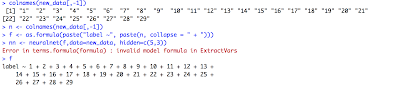
Ok, so you read a bunch of stuff on how to do Neural Networks and how many layers or nodes you should add, and etc... But when you start to implement the actual Neural Networks you face a ton of dummy errors that stop your beautiful inspirational programming. This post talks about some errors you might face when using the neuralnet package in R. First, remember, to use the package you should install it: install.packages("neuralnet") Then library(" neuralnet") to load the package. Error 1 One error that might happen training your neural network is this: nn <- neuralnet(formula1,data=new_data, hidden=c(5,3)) Error in terms.formula(formula) : invalid model formula in ExtractVars This happens when the name of the variables in formula "formula1" are in a non desired format. For example if you named your columns (or variables) as numbers you would get this error. So change your column names and re-run the model! Example: label ~ 1 ...

Running k-Means Clustering on Spark with Cloudera in your Machine

Image
Here are some steps to start using Spark. You can download a VirtualBox and a Cloudera Hadoop distribution and start testing it locally on your machine. Steps : Download kmeans.py example that uses MLLIB furnished by Spark. Create a kmeans_data.txt file that looks like this: 0.0 0.0 0.0 0.1 0.1 0.1 0.2 0.2 0.2 9.0 9.0 9.0 9.1 9.1 9.1 9.2 9.2 9.2 Download VirtualBox . Download Cloudera CDH5 trial version. Open VirtualBox, import the downloaded Cloudera's Virtual Box and run it. Inside VirtualBox: 1 - (needs internet access) Install python numpy library. In a terminal, type: $ sudo yum install numpy 2 - Copy kmeans_data.txt and kmeans.py to /home/cloudera/ (or wherever you want) 3 - Launch Cloudera Enterprise Trial by clicking on an icon on Cloudera's Desktop or run this command: $ sudo cloudera-manager --force --enterprise 4 - Open Cloudera Manager Webinterface on your browser. Here are the credentials for that: user:...

Error when using smooth.spline

When trying to interpolate a series of data the cubic spline  is a great technique to be used. I choose to use the smooth.spline function, from the R stats package. > smooth.spline(data$x,  data$y ) Nevertheless, while running smooth.spline on a collection of datasets with different sizes I got the following error: Error in smooth.spline( data$x,  data$y),  :   'tol' must be strictly positive and finite After digging a little bit I discovered that the problem was that some datasets were really small and smooth.spline wasn't being able to compute anything. Hence, make sure your dataset is big enough before applying smooth.spline to it. > if(length(data$x) > 30) {  smooth.spline( data$x,  data$y)  } UPDATE:  A more generalized solution would be: > if(IQR(data$x) > 0) {  smooth.spline( data$x,  data$y)  }

Working with Big Datasets in R

When dealing with a significant amount of data in R the are some points to consider. How do I know if my data is too big? Well, the term "BigData" can be thought of as a data that is too big to fit in the available memory. As R works with the entire dataset in memory (unless you specify it not to do so), the first thing is to check how large is the dataset in question, and if it does fit in memory . Remember that you actually should have at least double memory of the size of your dataset. So for example if you dataset has a size of 2 GB, you should have at least 4 GB of memory. If you don't have enough memory, you should consider breaking your data into smaller chunks and working with them separately. You can use the command split to do this in Linux: split -l 10000 file.txt new_file This should create several new files (new_filea, new_fileb, etc..) with ten thousand lines each. Well, once you know your date will fit into memory, you can read it with th...