Posts

Frequent Itemset problem for MapReduce

I have received many emails asking for tips for starting Hadoop projects with Data Mining. In this post I describe how the Apriori algorithm solves the frequent itemset problem, and how it can be applied to a MapReduce framework. The Problem The frequent itemset problem consists of mining a set of items to find a subset of items that have a strong connexion between them . A simple example to clear the concept would be: given a set of baskets in a supermarket, a frequent itemset would be hamburgers and ketchup. These items appear frequently in the baskets, and very often, together. In the general a set of items that appear in many baskets is said to be frequent . In the computer world, we could use this algorithm to recommend items of purchase for a user. If A and B are a frequent itemset, once a user buys A, B would certainly be a good recommendation. In this problem, the number of "baskets" in assumed to be very large. Greater than what could fit in memory. The ...
Error when building Apache components using non-Sun Java

Sometimes, when building some Apache Hadoop related components with non-Sun Java (such as IBM Java or OpenJDK) you may encounter the following error: java.lang.NoClassDefFoundError: org.apache.hadoop.security.UserGroupInformation I got this error while building Hbase, Hive and Oozie. And all times the problem was the same. When building a component that depends on Hadoop, your Hadoop jar should build with non-Sun Java as well. That means that you should rename some com.sun imports in Hadoop code, so it is buildable with other JVMs. Replace this com.sun imports with the correspondent non-Sun package. Usually the jar that causes the problem is hadoop-core.jar . Hope it save you all some work!

Apache Hbase unit test error

Building and testing Hbase 0.94.3 in Linux (RedHat and Sles) I came across with a error a couple of times, and solved it with 3 different approaches that I think might be good to share. Several testcases were failing due to it, such as TestCatalogTrackerOnCluster and TestLogRollAbort. I ran  mvn clean compile package , and got the following error: java.io.IOException: Shutting down at org.apache.hadoop.hbase.MiniHBaseCluster.init(MiniHBaseCluster.java:203) at org.apache.hadoop.hbase.MiniHBaseCluster.<init>(MiniHBaseCluster.java:76) at org.apache.hadoop.hbase.HBaseTestingUtility.startMiniHBaseCluster(HBaseTestingUtility.java:632) at org.apache.hadoop.hbase.HBaseTestingUtility.startMiniCluster(HBaseTestingUtility.java:606) at org.apache.hadoop.hbase.HBaseTestingUtility.startMiniCluster(HBaseTestingUtility.java:554) at org.apache.hadoop.hbase.HBaseTestingUtility.startMiniCluster(HBaseTestingUtility.java:541) at org.apache.giraffa.TestRestartGiraffa.beforeClass(Tes...

Dependencies on a Hadoop Ecosystem

Image
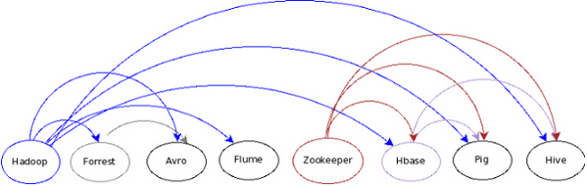
When building a Hadoop cluster and all other Apache projects related to it, it might be tricky to know what to install and how to install. You first should understand your data, and what you want to do with it. If you have log-like data, that keeps increasing all the time, and you have keep updating it to the Hadoop cluster, you might want to consider Flume. Apache Flume is a distributed deamon-like software ( and for that presents High Availability) that can keep feeding data to the Hadoop cluster. If you need a no-sql radom read/write database you can use Hbase , implemented based on Google's BigTable database. If you have relatively structured data and you want to do query-like analyses on it, you might consider Pig or Hive . Both work on top of the Hadoop cluster, executing commands instead of Java written MapReduce jobs. They both furnish their own language to execute such commands. Pig uses a textual language called Pig Latin, and Hive uses a syntax ver...

Duine Open Source Recommender

Image
Duine   is a open source Recommender System . It is a collection of software libraries developed by Telematica Instituut/Novay that intends to predict how interesting is an information to a user. It provides the collaborative filtering and content based recommender and other features, such as an Explanation API (explanations to why such recommendations has been made). Its result recommendations are quantified by a number, ranging from -1 to +1, being that the greater the result, the more interesting the item should be to the user. One of the main advantages of Duine is its well formed architecture. When it performs a recommendation, it can incorporate the user feedback to its systems. Also, it possess a switching engine, being able to analyse which method (content or collaborative) is better in the data situation, and dynamically change it. a . Architecture The following picture describes the main concept of Duine framework. b. Installation To ins...

Open Source Recommendation Systems Survey

Image
Here follows a survey I did back in 2010 when I was studying Recommender Systems. Hope it is useful. The growth of web content and the expansion of e-commerce has deeply increased the interest on recommender systems. This fact has led to the development of some open source projects in the area. Among the recommender systems algorithms available in the web, we can distinguish the following:   Duine , Apache Mahout , OpenSlopeOne , Cofi , SUGGEST and Vogoo . All of these projects offers collaborative-filtering implementations, in different programming languages. The Duine Framework supplies also an hybrid implementation. It is a Java software that presents the content-based and collaborative filtering in a switching engine: it dynamically switches between each prediction given the current state of the data. For example if there aren't many ratings available, it uses the content-based approach, and switches to the collaborative when the scenario changes. ...

Introduction to Apache Hive

Image
Hive is a distributed data warehouse that runs on top of Apache Hadoop and enables analyses on huge amount of data.  It provides its own query language HiveQL (similar to SQL) for querying data on a Hadoop cluster. It can manage data in HDFS and run jobs in MapReduce without translating the queries into Java. The mechanism is explained below: " When MapReduce jobs are required, Hive doesn’t generate Java MapReduce programs. Instead, it uses built-in, generic Mapper and Reducer modules that are driven by an XML file representing the “job plan.” In other words, these generic modules function like mini language interpreters and the “language” to drive the computation is encoded in XML. " This text was extracted from Programming Hive . Hive was initially developed by Facebook, with the intention to facilitate running MapReduce jobs on a Hadoop cluster, since sometimes writing Java programs can be challenging for non-Java developers (and for some Java develope...